4 idols we all worship in ignorance and how to depose them

image

Knowledge is power. This saying is so popular that the wise mouth that uttered it is largely unknown. It came from the golden-mouth of Francis Bacon (1561-1626), philosopher and former English Lord Chancellor. To say the least, the theme of knowledge was so central to his philosophical preoccupation that he lived and died trying to expand the frontiers of the human knowledge base. He actually died in the cold of winter while experimenting the phenomenon of freezing.

image

However, there is more to Bacon. Essentially, he set out to depose Aristotle from the very coveted intellectual position he has been occupying from the Ancient, through the Medieval to the Modern period. For him, Aristotle’s logic was not just misleading but wrong, and he took it upon himself to set the records straight. He would then come up with his Novum Organum, a replacement for Aristotle’s Organon. Don’t mind those words, organon simply means “instrument for rational thinking.” Novum is Latin for New. So, Bacon came proposing something new and, for him, better. This is definitely not a philosophy class, but the background might do us some good along the line.

Now to the idols. There was already a dominant thinking around town at the time, that the human mind at birth is a tabula rasa, a blank slate, upon which nothing has been written. Bacon disagrees, and goes on to saying that, given the function of the mind, which is to reflect reality or nature, the mind is, instead, a crooked mirror, given it’s inherent distortions. These distortions he called idols, which, so to speak, are images we hold and venerate in our minds, images lacking in substance. And so, they become obstacles to knowledge acquisition, they frustrate the possibility of true knowledge, they hold us to ransom and deny us access to substantial knowledge. Such are the characteristics of the Baconian idols.

image

1. Idols of the Tribe (Latin: idola tribus): Why is to err human? To err is human because there is an inherent error in the very configuration of the human person; how much our senses can deceive us; how much we can see what is not there and not see what is there; how well we can hear what was not said and not hear what was said.

You’re a worshipper of this idol if you trust your senses to a fault; if you’re good at insisting you saw or heard something even when everyone else says otherwise.

2. Idols of the Cave (Latin: idola specus): Every human being is a bundle of peculiar tastes and prejudices, borne out of education, exposure to certain literatures (books), experiences, peer influence, etc. The thing here is that the conceptions and doctrines gleaned from these sources are so dear to, and cherished by, the individual that they really don’t bother to go on fact finding; no need to verify.

You worship this idol when you can go all out to insisting that something is true simply because you read it up from a book or was said by so and so. You worship this idol when you base your judgement of what is right or wrong based on what you “feel” is right or wrong.

3. Idols of the Marketplace (Latin : idola fori): Because words are ambiguous, and because language can confuse things up, human communication can distort our understanding of nature. Have you noticed that we even have names for things that don’t exist, such as unicorn and dragon?

Those who are wont to defining things and engaging in unending linguistic analyses are worshippers of this idol. Those who peg specific meanings to utterances without leaving room for the possibility of ambiguity worship this idol.

4. Idols of the Theatre (Latin: idola theatri): This designates various philosophical systems, schools of thought, ideologies, etc., that people embrace to a fault. The problem is that they tend to interpret things from that vantage point without verification or leaving room for other possibilities. The people here are, more or less, set in their thinking.

Many philosophers and religious people worship this idol.

The Way Forward

Knowledge is power, remember?  Having known, it’s high time we deposed them. How do we do this? Simple: commit to mental improvement; improve your mind. It is particularly important that we endeavor to free our minds from these idols before embarking upon any knowledge acquisition endeavor.

We must purge our minds of these idols. With regards idola tribus, always bear in mind the shortcomings of the human senses. With regards idola specus, never forget that our sources of knowledge can be wrong. With regards idola fori, understand the nature of words and language and how they operate. And with regards idola theatri, inasmuch as we’re at liberty to subscribe to any philosophical system or quarters of thought, we should always remember that no one philosophical system is comprehensive.

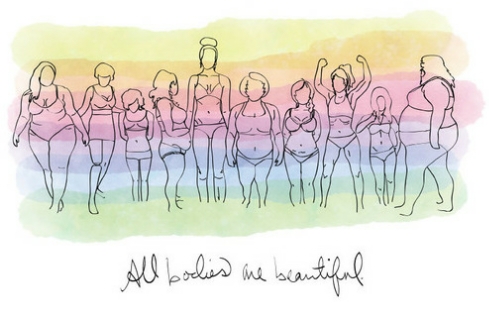
Question to Ladies: Who is the judge of beauty or decider of ‘ideal’ body type?

image
Who is ideal?

For the guys in the house, if you think that to be a man is not a day’s job, then try being a woman. Even for one day. Then I bet you’d stop wagging your tongue about the purported difficulty in being a man. Aside the fact that we’ve been socialized into thinking that it’s the man’s job to make all the money, hence the pressure it mounts on us to go crazily hustling, what else? I’m a guy myself, and I’m yet to find a more pressing concern on men than amassment of cash. Truth is, with a truckload of cash, a guy is the single best thing to be on the planet. Interestingly, cash commands all worldly goods; they’re at its beck and call. And I hope I’m not very wrong.

However, not so not so for the womenfolk. From biology to psychology, sociology to economy, the average woman is in trouble. Let me explain.

Biologically. If you’re not a woman, then don’t even try to imagine what menstruation and everything that goes with it feels like; merely content yourself with the stuffs you read in books about it. If you insist on imagining, then whatever your imagination produces will at best be close to the truth. What about pregnancy and labour? Don’t even dare it. Let’s just call them hell. The only thing that makes them make sense at the end of the day is the cry of a baby. Needless to say, every pregnancy gets the woman on the death row. Yes, shit happens, especially during labour.

Sociologically. At birth we get poured into ready-made moulds called gender roles. That’s the job description of socialization. While men are poured into the mould of freedom and license, women are poured into the mould of servitude and subservience – especially in traditional African societies. What inhumanities are female genital mutilation and breast ironing! What nonsense! I know what they mean, and the mere thought of them makes me sick. In fact, the system, and I’ve kept wondering who built it, sees to it that women are alienated, that they lose their person, in the bid to filling in their gender roles. And if you’ve got no idea what this means, then you surely can’t get how difficult being a woman can be.

Economically. Thank God things are turning around for the better now. Else, women used to be denied the right of pursuing a career, to work, to earn. Of course, the man who perpetrates the denial of this right knows that real power is equal to earning power. Her career prospects are streamlined to “house-wifery,” with a job description to match: sex machine and children making factory and housekeeper. And so, the possibility of starving her of funds becomes one of the punishment options available for her. She gets to explain how she got everything that didn’t come from the hands of her lord and master, and gets to always draw up a list of her needs and wants, for scrutiny, slashing, approval and funding, as if bidding for a contract. Too bad.

Psychologically. And this is the primary concern here. There is this pathologically sense of incompleteness that next to every woman feels. It is near impossible to find a woman who is just fine, who feels great about everything about herself, who can really mean it while saying, “I’m flawless.” Pitiably, if they aren’t complaining about the size and shape of their head, it’s about the looks in their eyes; if they had their way they’d manually punch a dimple into their cheeks. Their lips, complexion, breast type and size, height, hips, legs, etc., are usually not just fine enough. And let me shock you some bit more: labiaplasty (cosmetic surgery on the labia – a part of the vagina) already shows how far this craze can go. For your information, too, next to every part of the female body part has a corresponding cosmetic surgery.

And so, it all got me thinking, “Who sets the trend, who says what the ideal is?” I’m tempted to draw the curtain on this piece here, but let me say a little more to throw more light.

At this juncture, let’s experiment something. If you’re a lady, simply try this: stand up, join your knees together and observe if a gap formed between both thighs (and you could trying using you hand to run through the gap). Now, here’s the point: “thigh gap.” That’s what the gap is called, and while it made waves, many ladies virtually skinned themselves alive to get one. Here’s the painful part of it: the “thigh gap” ideal was set by the legs of the 21-year-old British model, Cara Delevingne. For God’s sake, how on earth must every woman’s thigh produce this so-called “thigh gap” beauty ideal? There is also the “bikini bridge” and the “collar bone club” – very funny things most women aspire to, forgetting that variety is the beauty of life.

Let me leave it here, then. And I ask again: “Who decides what is beautiful and what isn’t, what is sexy and what isn’t?”
image
Yes, we're all beautiful!

I wish to cause you to read Malcolm Gladwell’s “DAVID AND GOLIATH.” First of all, let me whet your appetite…

image

It means so much to me to start by articulating and conveying my sentiments of profound gratitude to my dear friend Ralph Abhademere who made sure I got this book; he had to send me (I live in Enugu) his very own copy from Lagos, and wetted my appetite for it with an over-the-phone review. Thanks Ralph. It equally behooves on me to thank in no small measure my long standing friend and mentor, Fr. Francis. Let me gist you what he did. He sent me a Galaxy Pro tab with these words: “It can help you do a lot.” From faraway Australia actually. Of course, you can trust that blogging only got better on tablet. Yes, to Fr. Francis & Ralph, I do especially care to say THANK YOU.

Back to the book. I’m not alien to Gladwell’s literature; on Obinna’s Udeh’s recommendation and Arinze Nwafor’s lending, I’d read every word of his Outliers. And I remember sharing the gist here. To say the least, Gladwell is a writer par excellence. His command of the English language is legendary, his knowledge of history is profound, and I’m tempted to think that his versatility is unequalled. He would end Outliers after a 300+ paged argument with the mindboggling words: The outlier, in the end, is not an outlier at all. Do find time to read that book. Let me quickly advice: follow Gladwell with patience, as he could roll out the entire history of the planet to make a point.

Now, his David and Goliath. That story is possibly the most popular story you find in the Christian bible; how the unproven lad, David, fell a gigantic warrior, Goliath. And whenever this story is retold, both the teller and the listener reach a conclusion that suggests that David’s defeat of Goliath is unusual and miraculous. Tellers of and listeners to this story emphasize to a fault the ‘hand of God’ in this seemingly questionable victory. In fact, this story readily serves a worthy example whenever the topic of discourse hovers around an impossible turnaround. And you may continue to hold unto this thinking until you watch Gladwell  retell the story.

And that’s exactly what Gladwell  does in his book, David and Goliath. He retells the story, and then makes us see that we’ve been entirely wrong in our perception of that story. You may wish to immediately turn to First Samuel Seventeen, this time reading slowly and keenly to see what you didn’t see before, to find what your preacher couldn’t find. If you still can’t find why the victory rightfully belonged to David, then Gladwell’s book is a must-read. However, let me give you a clue: Did you notice that Goliath was led down that valley by someone? Why? Did you notice that David only had his his shepherd staff, but Goliath saw more than one, saying, “Am I a bird that you come to me with ‘sticks’?” He certainly couldn’t see well. And he would go on to betray himself by inviting David to “come to me.” Why not go after David. And I trust you really don’t know the place of slingers in ancient battling; how dexterous they are and how precise they can be in taking shots. And that was David; he was already so good at ‘slinging down’ lions and bears in the bush.

Gladwell  couldn’t have ended with the story. He goes on to situating it within various contests, reiterating the fact that underdogs and misfits and the disadvantaged can stand up to, and even defeat, giants, elites, and the advantaged. And this exposé can already see you rising up to the challenges and threats posed by those who we are wont to thinking are cut-out for the top.

Read David and Goliath. And if you find it interesting and life transforming, a bottle of beer is just fine by me. For this referral. lol!

52791d10d67c1513cb44bd465f3afe7e

Rethinking the proper place of money on the scheme of things

image

If the love of money, as St. Paul instructed Timothy (cf. 1 Tim. 6:10), is the root of all evil, then the lack of it is what? By my tunic, the lack of money is as good as the love of it – the root of all evil. Period! As much as the love of money has motivated horrible things, so has the lack of it unleashed untold mayhem on those affected. Let’s be a bit more point blank here. People have watched dearly beloved ones die of both preventable and curable diseases simply because they couldn’t procure medicaid. People have lost next to everything to greedy relatives because they couldn’t afford the services of a lawyer. People have dropped out of school and lost their chances of finishing up on the sunny of life because they or their sponsors couldn’t foot tuition. What is more, the lack of money has proven to be capable of crashing the party of one’s life. To say the least, food, shelter and clothing, which are the very basics of life must be bought – with money.

And then the presence of money. There is a seeming consensus that money makes the world go round, that money comforts the present and secures the future. Of course, there is no gainsaying that money is the passport to travelling the world, playing ownership to exotic toys, hanging out with sophisticated women, acquiescing with the nobles and the “mightiests” of the land, having a say in matters of state, having a stake in the big businesses in town, being greeted obsequiously and treated to royalty in public, cruising in speed cars and living in palatial homes. Isn’t money so beautiful? Of course.

image

Truth be told, before British Pounds or American Dollars, Indian Rupees or Nigerian Naira, the emotion elicited is the very same. The reason is not far-fetched, as they’re basically the same passport, only with different coats of arms on them. The chase after money is so hot and the pursuit of it so swift that one begins to wonder what money is all about. Why would someone, for instance, disregard his/her health in this hot chase after money only to end up spending most or all of the money made on recovering from ill health? Why would a parent, for instance, devote so much time and energy in the hot chase after money, with the goal of providing his/her children the best possible education, and ends up been estranged from his/her family because he/she failed woefully in apostolate of presence? The whys are many. Personally, I quite don’t get it, especially how the place of money is overrated.

Yes, the place of money is overrated. And, at this juncture, it behooves on us to call a spade a spade. It is this: money is only a means to an end and never an end in itself. Never forget. Money is never as important as the good life it secures, it is never as good as the good educational opportunities it affords, it is never as wonderful as the good health it ensures through the procurement of good food and access to quality medicaid, it is never as fun as the fun it bequeaths a home, and it is never as interesting as the people it draws close to us.

In essence, be both keen and quick to convert money to purpose. As soon as you can afford something of value to your life and happiness, go get it. And stop glorying in a fat bank account. As soon as you can take your significant other outing, go get it done. And stop thinking of it as a waste or loss of money. Come to think of it, what was the money meant for in the first place? As soon as you can afford a better neighborhood, move! And stop tying yourself downtown. As soon as you can afford further studies, start. For God’s sake, that’s what the cash is for.

You must immediately realize that there is not point where money is ever enough. It is so funny that the craving for more gets crazier by having more, which is exactly why one should savor the sweetness of one’s financial status at every point. If you can afford a Jeep, get yourself one; if you can’t, buy what you can. When you can comfortably afford shopping cloths in a boutique, what are you still doing with open-market clothes? If not for religious reasons, then stop being miserly on yourself.

Finally, I request that you don’t get me wrong. I’m not asking you to go blow up your savings or drown your investments in order to feel your class. I expect you got the simple message I’m passing across: use money; don’t live for money.

“It was a terrible experience.” Let me gist you…

image

The past 3 months have been some of the very best of my entire conscious life, one that has already redefined the rest of my life. It’s been Teaching Practice, one of the 15 courses whose requirements I must fully fulfill to bag a post graduate diploma in education, PGDE. While the entire PGDE programme on its own is a fat story, I’m choosing to streamline the gist to TP.

It was an amazing experience for me. Because of my passion for excellence, and facilitated by Ma’am Uzor, I got myself one of the elite schools in town. The particularly beautiful thing about this experience was that it pushed me, it challenged me, it transfigured me, and, then, repositioned me. It pushed me because the set of of rules I was to abide by needed me to go the extra mile. It challenged me because my students were always on me to deliver; they were of an uncommon breed. It transfigured me because my views about a number of things changed; radical change, I mean. It repositioned me because the ensuing change in mentality set me on a new pedestal.

More so, the different categories of people I encountered there impacted on the different areas of my life that needed a touch of betterment. For instance, my students and supervisors turned me from student-teacher to full-fledged teacher, the management turned me into a promising administrator, and my colleagues, who were predominantly family people, exposed me to “Home Economics 101.” To say the least, it was an awesome experience.

Not so, not so for Mrs. Okafor. According to her, “It was a terrible experience.” It was a terrible experience because she practiced teaching in a system where things have fallen apart, where it has collapsed. Where the students are wild, where the management is nonchalant, where the teachers are burdened by inferiority complex, where the teaching and learning and living (boarding house) facilities are terrible, to say the least.

She especially recounted a particularly embarrassing experience. She had walked into the classroom in a flat shoe, and after minutes into her period (teaching, I mean) she felt cold and heavy in her legs. Guess what had happened? She didn’t particularly notice that the classroom was flooded and that she had been swimming in it all along, and because she’d lose her pair of fine shoes if she attempted to walk back to the car in it, she resorted to the only thought that came to her mind, “Pick it up and walk barefooted to the car.” It took the intervention of one of her students who walked up to her with a pair of slippers while she was already on her way to the car on barefoot.

She told other stories to the effect that it was a terrible experience; an eye-opener experience. We can already begin to imagine what the future holds for girls who lack basic training, who’d dig it out with one another at the slightest provocation. We can also begin to imagine what the future holds for girls with raw and unbridled tongues, tongues that wag with the frequency of an excited dog’s tail. We can, more so, begin to imagine what the future holds for all of us; we must all be affected in one way or the other. Of course, we can already see that the Niger Delta Avengers are frustrating the effort of the Harvard-schooled NNPC boss, Ibe Kachikwu. “At the end of the day,” according to Lawrence Onukwube, “the poor can’t sleep because they’re hungry and the rich can’t sleep because the poor are awake.”

We must all renew our commitment to qualitative, meaningful and functional education. It is not only right and just, it is a duty, plus our collective future squarely depends on it.