
WHY I’M A FEMINIST – BUT HATE FEMINISM

pixccccc

A feminist is a person, male or female; feminism is an ideology, and being an ‘ism’, it shares the collective limitation of all ‘isms’ (capitalism, socialism, communism, humanism, radicalism, lesbianism, constitutionalism, etc.). And what is this collective limitation, one may ask. It is this: they are at best half-baked and at worst badly-baked ideologies; they stretch their ideals to the limits in the process of which touch with real life is sometimes lost. For instance, while capitalism prefers profit to human welfare, communism prefers human welfare to industry; neither of capitalism and communism is very correct. Of course, we’re working with capitalism because it is, in more ways than one, the lesser evil.

I’m a fan of Chimamanda’s. I like the fact that she’s a feminist and sticks her neck out to trumpeting why she thinks the existing gender structure is fraught with more negatives than positives. She first bought my admiration by her “Danger of the single story” (TED talk), which UNN’s Lionfm played every other morning of my Nsukka days. I especially enjoyed her 2015 graduation speech at Wellesley College in the US and her “Why we should all be Feminists” (TED talk). Her books – Purple Hibiscus, Half of a Yellow Sun, Americanah – are even some of the finest books on the planet, and a budding writer like me should like her for her ‘wordsworth.’ However, Ms Adichie isn’t responsible for my feminist bent; she didn’t influence me that far. I only came to discover that we share similar views on gender and social engineering. And if you insist that a feminist must profess feminism, then we both belong to a feminism type that is unique to us: we don’t fight about it; we merely state the obvious and leave the rest to ‘your’ reason.

I became a feminist watching my mother, interacting with the women in my personal space, observing the generality of women, studying philosophy and coming out different. I became a feminist when my sense of justice, right and wrong developed. And when it did develop, some things just didn’t make sense anymore. There were things I couldn’t tolerate anymore about this whole gender stereotyping. Why on earth, for instance, should my dear sister be inferior to me – in any sense – because she is feminine? Why on earth “must” a man have something when there is a woman that could make a better delivery of the role? Why, why & why? I’m not saying this because I want to win the admiration of concerned women, but because I quite don’t get it! I don’t even understand St. Paul instructing Timothy to have women ‘shut up’ in church.

I’m a feminist because I believe in the equal access to opportunities and prestige by men and women. I’m a feminist because I believe everyone should be more merit-oriented than chauvinistic; meritocracy has remained a core value of worthy organizations. I’m a feminist because I believe in the democratization of service; everyone should serve. I’m a feminist because I need my lady-friends to be the very best of themselves and not be limited by anything artificial that goes under the aegis of ‘gender roles’. I’m a feminist for every good reason that you can think of. Yes, I preach ‘complementarity’ and decry ‘subjugation’.

Don’t get it twisted. I know enough about social engineering. I know that there ought to be some sort of roles, functions and ideals in order to achieve social order, leading to collective progress. But I also know that those that sat at table to decide the present structure didn’t mean well enough for the collective lot. If you know what Female Genital Mutilation, FGM, is, especially its four types corresponding to levels of intensity, then you’ll agree with me that that idea came from the pit of hell.

On my part, I really can’t think much of a man who dares says to a lady, “C’mon keep quiet and sit down, you’re ‘just’ a woman?” What is ‘just’ about being a woman when my very own angel mother is one? I blame the lady too who would dare open her mouth and say, “Don’t you know I’m a lady?” Am I blind? Even a blind man knows you’re a lady by the electric charges you fire at him. I especially blame the custodians of the perpetration of gender inequality who succeeded in making her think so.

Mind you, the husband is not superior to his wife in any sense; he’s only “primus inter pares” – first among equals. He is not first by right but by privilege. And the problem with every privilege is that it has the capacity to blind – and has blinded many a man. I pray for us men, that we may regain our sight, and that we may see what the future of gender struggles holds for us. Yes, it’s such a struggle where everyone gets to lose. Someone said it best: “In a family fight… there is no real winner as the entire family is the ultimate loser.”

I hate feminism, at least as we experience it in practice, for one reason: It seeks revenge instead of redress.
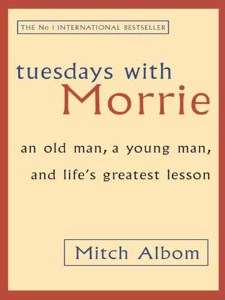
Have you read TUESDAYs with MORRIE? Then let me gist you…

tuesdays-with-morrie

 “Tuesdays with Morrie: an old man, young man, and life’s greatest lesson” by Mitch Albom is as a thriller as it is unconventional in concept and style. I can quickly remember a number of times that movies moved me to tears, but never had a book done that to me until when I was buried in the pages of this great book. What is more, nothing about me, especially my values, remained the same anymore. And I can tell you for a fact that Tuesdays with Morrie is a must read.

The book is more of a report than a prose or drama or motivational. Mitchell Albom took to reporting the proceedings and content of his life-transforming Tuesdays meeting with his dying professor, Morrie Schwartz. He introduces the book thus:

The last class of my old professor’s life took place once a week in his house…. The class met on Tuesdays… The subject was the meaning of life. It was taught from experience. No grades were given… No books were required, yet many topics were covered, including love, work, community, family, ageing, forgiveness, and, finally, death… A funeral was held in lieu of graduation… the last class of my old professor’s life had only one student. I was the student.”

Mitch goes on to give a fitting description of his book in the following words:

“Although, no formal exam was given, you were expected to produce one long paper on what was learned. That paper is presented here” [i.e. the book Tuesdays with Morrie].

Let me spare you the rest of the book. I’ll love you to read it for yourself. Buy a copy on amazon or do a free Google PDF download.

PIETÀ SPEAKS: 4 Lessons from this Michelangelo’s masterpiece

The Pieta

The Pieta

Very few people know that the golden roof, the marble walls and the majestic halls of the Vatican is not the exclusive preserve of the Roman Catholic Church. Aside being designated as one of United Nations’ heritage sites, major work cannot be done on any of its breathtaking features without the ‘apparent’ permission of the Italian government. A typical example was when the Vatican proposed a repainting of the ages old Sistine Chapel, which, as it were, would affect two of Michelangelo’s breathtaking frescos: The Last Judgment and The Creation of Adam. Of course, the Italian government reminded the Vatican that those frescos are untouchable.

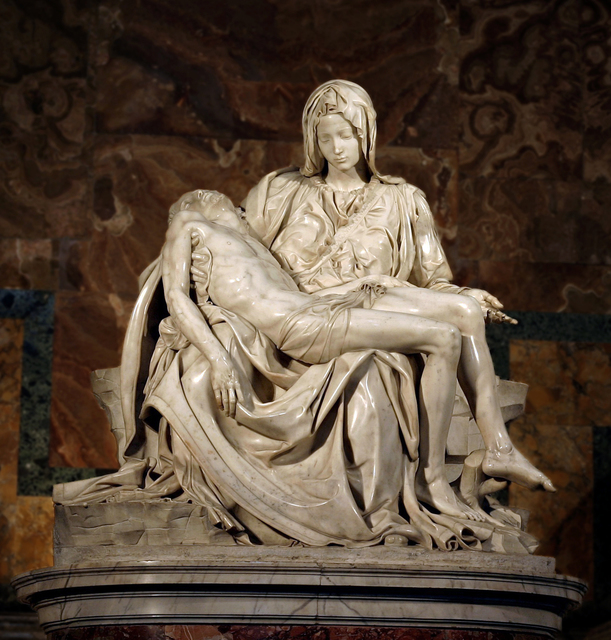
The Vatican is a must-visit for a number of reasons, including: pilgrimage, tourism, and education. As a great pilgrimage center, it plays host to the burial chamber of St. Peter; St. Paul was martyred there too. And Emperor Nero and his likes had fun slaughtering the early Christians in the nearby Roman Colosseum. As a tourist site, millions of people visit the Vatican to behold the genius of Pope Julius II and the ingenuity of Michelangelo – with the Sistine Chapel frescos and the Pietà (artwork depicting the body of Jesus on the lap of his mother Mary after crucifixion) standing out; even the dome of St. Peter’s Basilica was Michelangelo’s handiwork; he even designed the uniform of the Vatican’s Swiss Guard (her elite military force). Of course, the Vatican is home to the great pontifical universities, especially the Urbanian.

Michelangelo’s Pietà speaks to us today. Yes, it speaks, and yet speaks. It eternally speaks the message left in her by its sculptor, the finest one the world has ever known – Italian Michelangelo Buonarroti. What is this message? It is this: When we give not just our best but our all to our craft, then the worst output we can get is ‘near perfection’. The Pietà itself is perfect art. Take a look at the picture again.

Lessons >> How did Michelangelo do it?

  • Pietà wasn’t his first work: Usually people want to hit world class at the very first instance. No! You can trust that Pietà wasn’t his 1000th He had been in the game of painting and sculpting for God-knows-how-long before turning out the Pietà and the Sistine Chapel frescos.
  • Commitment to Excellence: Pietà is breathtaking because of the excellence it embodies. And excellence don’t just pop up from the blues; someone had to exemplify it. Michelangelo chose to. So, too, can each and every one of us.
  • Patience is a virtue: A look at Pietà would suggest it was done in ages – about a year actually. In fact, all the details of the human art form were given to the very last detail. Without patience, little can be achieved and excellence would remain unreachable. So, to really get the details out and exemplify excellence, patience is nonnegotiable. Patience gives the world time to reset in our favour; nurtures genius and bolsters creativity. Whenever we’re not patient, we’re more or less compelling time, things and people to offer what they don’t yet have – but will soon have. Why not wait for that mango fruit to ripen by morning? Why insist on having it now?
  • Great works live on: For being a great piece of art, Pietà is a globally relevant artifact – and Catholic religious icon. It is priceless to say the least. Millions of people from all over the world troop to see it every year. If Pietà were not that amazing, who will even care about its name? Perhaps only the Basilica’s cleaners. And so, Pietà inspires us to do great works, with the realization that they stand the chance of being transgenerational.

A KILLER SOLUTION TO UNEMPLOYMENT

thinking

International Business Machine, a strong name in computer and digital technology, has on the doors in their offices this striking line: “THINK. THINK. THINK.” Just a glance at it will reveal that we’ve one word – “Think” – repeated three times, and with a full stop marking off each and every one of them. You can trust that those words are not just there for the mere sake of having something on the door. No. It is their corporate philosophy, and inscribing it on doors is their way of selling the message to employees and customers alike. It is important to immediately state that every one of the three ‘thinks’ brings something new to the table. The apparent repetition carries the dual meanings of “emphasis” and “intensity.” By asking us to think thrice, they say that thinking is everything on the one hand, and they request us to think harder when we think again and rethink our thinking on the other hand. And so, IBM says it all: “Think. Think. Think.”

There is no gainsaying that it is rationality, which is our ability to reason/think, that makes us different from all other animals. French philosopher René Descartes even has it that thinking is the basis of the individual human existence: “I think, therefore I exist.” Yes, thinking has been, and remains, humanity’s best ally. We “thought” our way out of the Stone Age, and through the various ages of human civilization to this Information and Technology Age. In fact, thinking is, and remains, at the heart of science, arts, and the humanities. When we’re threatened by a situation, as an individual or a group, we think our way through and out of it. Leprosy, HIV/AIDS and Ebola know what I’m talking about.

I dare to announce that the multifacets of life can be meaningfully, effectively and efficiently related with through thinking. And employment status is not an exception. Now that unemployment rears its ugly head on our teeming youths in general, and graduates in particular, thinking is capable of rescuing the precarious situation. For want of thinking, that sort of IBM’s thinking, quality thinking I mean, many have cowardly embraced their fate, and are wallowing in poverty for that. Some others, for want of thinking, too, have taken to the blame game, blaming the government, economy, employees, parents, school system, and all blamables. But we know for a fact that the blame game is only good at shifting responsibility, such that the blamer ends up feeling good about him/herself after having transferred liability.

For want of thinking, others begin to pile up tonnes of excuses, dishing out, as it were, a thousand and one reasons why they’ve done little or nothing. A number of the award-winning excuses include: lack of startup capital, unfavorable government policies, hostile business climate, bad transport and power sector, big businesses wielding unfair advantage over startups, field of study been saturated, issue of unemployment, etc. Of course, the problem with excuses is that a million and one of them are capable of changing nothing.

However, a decision to take the IBM’s thinking route, to think again and to give the dominant thought a rethink, will deal a below-the-belt-blow to unemployment. What if we decide that we and we alone own our lives, and as such bear 100% responsibility for our lot? What if we choose to think about the fact that we come from the same country and share similar collective fate with the richest black man on the planet – Aliko Dangote? What if we think that almost next to everything has got economic value and can metamorphose into a viable and thriving business – sand, water, food, sticks, fruits, etc.? Does it even matter if the job is white collar, blue collar or pink collar, provided it can put food on our table? Have we thought of what practical relevance our courses of study can be of, what social problem it can solve or what need it can meet?

This is the point: Let’s think our way out of each and every situation we find ourselves. And try to use the IBM-model of thinking. Plus, we owe ourselves a job if we’re still unemployed.