One thing more important than hard work in the pursuit of success, and why Malcolm Gladwell’s OUTLIERS is a must-read

image

Come to think of it, how did Bill Gates become so successful that he’s remained the undisputed richest man on the planet for an impressive number of years? “Forbes” is a reliable source. A number of factors could be said to be responsible for that, including hard work, smartness, solid work ethic, shrewdness, and what have you.

However, all the preceding identified factors relating to Gates’s outstanding success count for nothing in the face of the most dominant factor. What is this factor, you may be wondering already. It is this: LUCK (the version of it I personally work with is GRACE). Yes, Bill Gates was lucky. He himself knew about this very well and would say it so often that the producers of one of the biographical documentaries on him opened it with Gates’s uttering of the words: I was lucky. And would you be surprised to know that one of the biographical documentaries on Steve Jobs opened with Jobs’s utterance of same words? Indeed, both transgenerational legends know they owe their success story to luck, far more than they can ever owe it to any other determinant or predictor of success.

This is where Malcolm Gladwell’s OUTLIERS come in. I just ate up the book to its very last word and I’m far better off for it. And the best I can offer you right now is insist that you do all you earthly can to grab a copy and eat it up! You’d be glad you did.

Malcolm Gladwell is not just an awesome writer but a critical thinker and a catalyst for rapid personal and societal development. His ideas are breathtaking and his solutions are revolutionary. Else, who would have thought that “luck,” playing out in as much as one’s date of birth and ethnicity, is the single most important predictor and determinant of success.

How could we have known that the Asians owe their mathematical prowess to their language? How could we have known that the rice paddies of China produced the most resilient human beings in the world? How could we have known that growing children “concertedly” was better than letting them evolve just that way? How could we have known that the Korean Power Difference Index, PDI, was responsible for the repeated crashing of Korean planes – until something was done about it? We really wouldn’t have known until someone gave the whole scheme of things a rethink.

Reading Gladwell’s OUTLIERS, I resolutely came to the conclusion that there is no such person as a “self-made man or woman.” Even Gladwell agrees with me when he concluded, thus: “The outlier, in the end, is not an outlier at all.”

OUTLIERS will humble you; it will leave you more grateful than you already are – especially to unusual events and forgotten people. And, it will make you focus on creating more advantages for people instead of whipping them to work harder.

Who is an outlier? Find out.

*myGratitude: to Obinna Udeh for recommending the book; to Arinze Nwafor for lending me his copy.

Why we must always discuss gender equality within the ambience of social engineering

image

I’ve always maintained that my sense of gender, and more so my advocacy for gender equality, didn’t develop in adulthood; the three amazing human beings (mum, Ada and Nne) with whom I spent the first 12 years of my life made me realize that advocacy for gender equality is every real man’s job. And so, I always had it from childhood. To say the least, they so loved me and did next to everything for me that I can only think so highly of them. The thought of going to school without Nne, my younger sister, for instance, made me sick; though quite younger, she was such an equal, and always suggested the next move with facility. Ada is 5 years older and always gave me a reason to put up a fight, and I never won any of those fights; I never lost either since mum always came to the rescue of her dearest son. And then mum was my angel; she loved me thoroughly as all I need do was ask – anything.

While I basked in the euphoria of an amazing childhood, one filled with lots of laughter and love, I didn’t know that as part of his morning prayer, the ‘ancient Jew’ (I’m not sure about now) thanks God that he wasn’t made a woman. There is no gainsaying that this is informed by the no-pride of place women were accorded in that society; a woman was essentially one of her husband’s possessions – ranked with his house, cattle, and stuffs. For them, too, a woman was religiously unclean in more ways than a man can ever be, especially during her monthly period and after childbirth. With all due respect to Jewish rich heritage, those inhumanities meted out to women were largely uncalled for. To call a spade a spade, it was squarely the case of social injustice. Too bad.

The Jews are not as guilty as traditional Africans in the inhuman treatment of women. For me, and for a good number of people, female genital mutilation, FGM, is the biggest social evil. What about sex slavery, what about underage marriage, what about honour killing, what about female-child molestation, what about rape? What about the fact that in some African societies it must always be the woman that killed her husband, and she’s made to swear in the most despicable way – like drink the bathwater of the corpse – that she didn’t do it? What about the fact that she gets to get nothing on the demise of her husband – if there’s no child to show for the marriage? What about the fact that there is a differential payment regime for men and woman – for equal work! These reasons are just enough to trigger and sustain the fight for gender equality.

Come to think of it, it really doesn’t make sense to think that there is anything so special about being a man – over and above being a woman. It just doesn’t make sense. Frankly, it really doesn’t. To say the least, a woman is as special as a man, and since everyone is special, it does us no good talking about it.

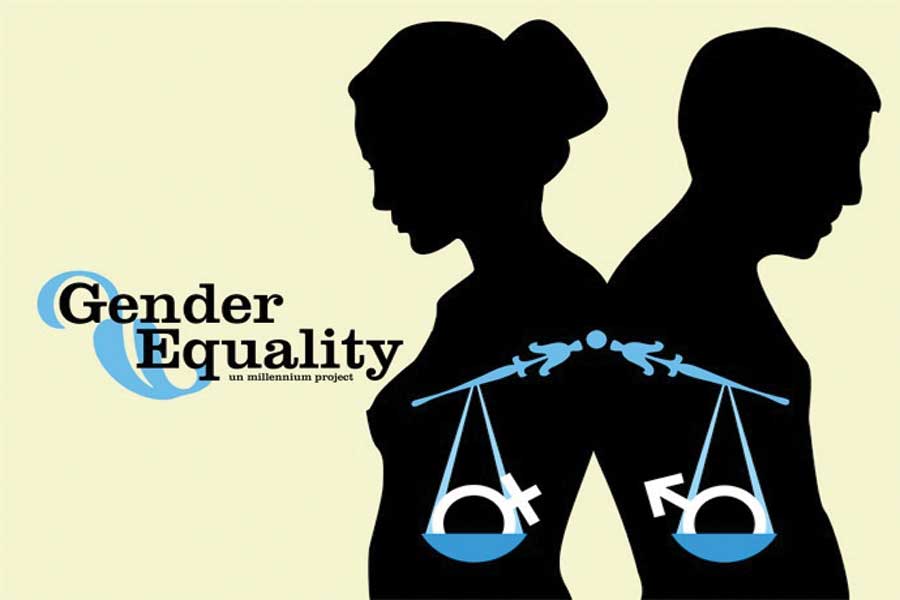
However, we must be sure to advocate for gender equality within the borders of social engineering; we must keep in mind the irreplaceability of gender roles. Given that no two different things can be equal in any respect, the ‘equality’ in ‘gender equality’ does not imply mathematical equality, such as expressed in 1+1=2. No, it speaks of social equality such as expressed in 1+1=1. To this effect, we must stop engaging the concept of gender equality wrongly. And one way of doing this is to always make recourse to social engineering.

By social engineering is meant the manner in which society is organized and run so as to stay up and running. One of these ways is the assignment of gender roles, reflected in the fact that men should be this and women should do that. You probably can already see that gender inequality was born here, where, like sharing a piece of cake to two people, one got a lion share and the other got both the left over and servitude. But remember that nobody assigned the woman the role of childbirth and uncommon intuition; nature also assigned gender roles, like who inseminates and who carries, delivers and breastfeeds the baby.
image

The reality of social engineering thus explained, one can already see that pursuing mathematical equality will put a knife on the things that held us together and we would have fallen apart before we knew it. With this, marriage degenerates into competition and the leadership hitherto supplied by the headship of manhood becomes threatened.

Why not we define gender equality in the following terms: the expunging of inhumanities meted out to women; the empowerment of women to explore the myriads of opportunities that colour our dawn to dusk; the respect and recognition of women in marriages by men and in-laws, wherein the man is only primus inter pares – first among equals; the socialization of the girlchild to aspire to the noblest aspirations possible without conceiving of any barrier whatsoever; to remind women that motherhood is as much a career that demands excellence as are the legal and medical practices; to remind women that no matter how much the man puts into the child’s upbringing, she must necessarily supply the lion share, having received so much in this regard from the Creator…

On the whole,
image

The game of life and the game of snooker: similarities and lessons

image

image

The game of snooker is pretty much like cycling, where the knowledge settles in like forever. Even at that, I was shocked that I could still flow with the game, given that I last played it 10-12 years ago. Yes, I had a privileged childhood, one that saw me try my hands on many things, including soccer, tennis and trading.

The big deal about today’s snooker outing is that it made more sense to me than it did the last time I did. This time, as different from last time, the game reflected a picture of real life and became my teacher. I just could see next to everything that obtains in life depicted on the game.

And so, I wish to share on this platform some of those facts of life that echoes from the snooker game. To say the least, and in a sense, life is snooker.

1. The variety of balls on a green board: The very appearance of the game speaks volumes about life already. Variety is the spice of life we say; the variegated colours of the snooker balls re-echoes this. We say men are in sizes, and the differential values of the balls reflect this. Plus, we say the land is green, and the snooker board itself is a green one. And so, facing a snooker board is like facing life.

2. Everyone starts out equal: All men are created equal – though not really born equal, given the unfair advantage some enjoy from birth. For the game of snooker, both players start out equal; no one owns either of the “spot” or “strip” balls from the word go. Eventually, the first “potting” makes that decision; the first “potter” gets what he sent into the “pocket.”

3. Chance and choice play out on the board: Pretty much like life, we get both what we bargained for and what we didn’t bargain for. You want to pot your ball and you find that it was the other guy’s own that went in; you try to do this and the other undesirable thing got done. And truth is that more than once in a given game one would find the odds in one’s favour. Of course, it is more of choice: you want something, you go get it!

4. The rules reign supreme: Like life, it is a game of rules; many rules. And you’ve to abide by them or be punished. It is squarely a game of sowing and reaping; no excuses whatsoever! The punishments are straightforward, and may be as much as loss of the game itself. So, the player must behave him or herself and be very open to accepting those punishments.

5. Vision is everything: Vision means as much in snooker as it is in life. You just need to see well enough and calculate moves ahead. Without vision in life one perishes; without vision in snooker one loses. That’s just how it works.

6. Your word is your bond: There are a number of interesting ways of losing a snooker game. The most annoying one is the best teacher. After potting all of one’s balls, the decider of the game is the potting of the “black ball.” But it must be done one way: say the one of the six pockets you’re sending it to and ensure that’s the very pocket it gets into. To say the least, you’re bound by your words. Anything other than that means loss of the game – to your opponent. In snooker as in life, your word is your bond; when you say you will do something, do it!

7. External forces conspire for or against one’s favour: To start with, the balls are driven by the “cue.” You just get to wish the cue does your bidding or be sanctioned. You want it to pot a “strip” and it instead ends the game by potting the “black.” You want it to simply pot the black, and it pots it and goes in with it – loss of game! There is also the “cushion” that helps to bounce the ball around the field of play; it could make or mar your game. Mind you, it’s nothing personal as some days are just like that.

It made sense playing snooker again. I guess I should do it more often.

The story of Nigeria and the developed world, and why we’re 100 years behind them

NigeriaReport-400x400

Let me quickly talk about Dubai. 60 years ago, Dubai wasn’t on the map of the world as we have it today, nor was it anywhere close to the top of the global scheme of things. Dubai meant next to nothing to tourists, there was no business to attract investors, and the people were just there being busy subsisting on fishing (being a coastal area) and other activities befitting of rural dwellers and a grossly underdeveloped populace. And then she struck oil in 1966 – exactly 10 years after Nigeria’s 1956 discovery of large reservoir of the liquid black gold in Oloibiri, Bayelsa State – and got started on oil exploration. Now, this is what the Ruler of Dubai did differently. He inquired from experts how long Dubai’s oil boom was going to last, and they furnished him with the projections. And guess what he did? He decided to principally use the huge cash raining into state coffers to transform Dubai, put her on the map, and provide her with a plethora of alternatives, especially the tourism option. Of course, you know the present story of Dubai better than I do. Do the math, from 1969, when Dubai’s oil exportation started, to date is how long? It was already done in less than 50 years; they’re only dotting their ‘Is’ and crossing their ‘Ts’ now.

Israel is worth talking about, too. Remember that aside the records we have in the Bible chronicling the lives and times of ancient Israelites, there was no geographical enclave in the new world order called Israel, not until it was created by the United Nations in 1948. And so, in 1948 an empty parcel of land was curved out from some of the countries of the Middle East and allocated to the Jews. Of course, with recourse to Israel’s ancient landmarks. Then they started from the very scratch on the project of building the Israel we know today, a global force to reckon with. However, the Israel we know today isn’t the ‘direct’ handiwork of the El Shaddai. No, it took one stroke of genius from the Prime Minister to change everything for good forever for Israel. What was it that he did? Just one educational policy: everybody must get an education. And he saw to it that a parent who didn’t have his/her child in school must be in prison. To merely say that education is compulsory in Israel is to say it lightly; it is indeed way too compulsory.

The United States of America, unarguably the very first country of the planet, is not left out. It is so easy to be carried away by her military might and profound influence on the global economic and political scheme of things and forget that the New World that Christopher Columbus discovered was a very crude place that only brimmed with potentials. The West Indies that occupied that land were just there; there was particularly no looks in their faces that would have attracted a foreigner. Even at that the arrival of the earliest set of immigrants to this Land of Opportunities, the place remained largely the same until a new spirit was created for them, the American Spirit, which also came with the American Dream. Till date, every American has the American Spirit as a constituent of their DNA; you just know an American when you see one. And they are all preoccupied with the task of realizing the American Dream. Let’s name them: the American Spirit or philosophy is Pragmatism, and the American Dream is Equality.

Let me not forget Germany. If Adolf Hitler never existed in German history, then Germany would have far outpaced America in the race of development and the pursuit of excellence. Hitler, as it were, raised them up to the very peak and crashed them down to the bottom. I beg to leave out an in-depth analysis. However, the point in question is that the philosophy of the likes of Hegel, Nietzsche, Feuerbach, Kant, especially Hegel’s concept of Absolute Spirit, and its activities in human history, created a formidable national consciousness in the people, a consciousness of excellence and the pursuit of bestness.

Then Nigeria. We’re already pretty familiar with the status quo. And why I started-off with the story developed folks and how they did it is to help us juxtapose, to do a side-by-side placement of Nigeria and the rest of the developed world. This placement, if well and sincerely done, will automatically reveal that we’re at least a century, 100 years, or even more, behind real-time development. Don’t get it twisted. I’m a patriotic Nigerian; I love Nigeria more than you know. And it is this very love for Nigeria that got my eyes on other people’s businesses, which got me contemplating the reason for our underdevelopment and digging into the source of their development.

And you must believe me when I say I’m well travelled – Nigerian travels, I mean. I was born and bred in the Ogoja-axis of Cross River State, and while there got to visit close to all its 18 local government areas. Now let me gist you. I left CRS in 2008 for university in Enugu State where I come from, and whenever I mention to my friends that I was coming over from CRS, they would quickly begin to think I lived in Calabar, not knowing that I visited Calabar just once all my stay there and lived more than 5hrs drive away from Calabar. You can trust that Calabar is one of the most beautiful cities in Nigeria, but be rest assured that Calabar is just a small portion of CRS and is in no way representative of the entire state’s development experience. I also know that Port Harcourt, the Garden City, is in no way representative of the Rivers State development experience. I know that Lagos Mainland is a far cry from Lagos Island, for which Lagos can’t be said to be authentically developed. Abuja is the same. My Enugu State is the same. And suffer me not to talk about the Middle East, North and Far North.

And so, you can already see that basing Nigeria’s development story on what happens on Lagos Island, Abuja Municipal, Enugu Urban, Port Harcourt City, Kano, and what have you is to falsely engage the Nigerian story. The one distinguishing feature that runs through the Dubai, Israel, America and Germany stories is vision. And where there is no vision, the people perish. That’s where we are.