The Godfactor

God-Factor220121

Ulysses (Latin) or Odysseus (Greek) saw his ears without a mirror when he challenged the instrumentality of the gods to his leading the Greeks to victory over the Trojans. Before his very own eyes, the sea-god, Poseidon, had sent a mighty snake to drown the soothsayer who was about revealing the trick behind the Trojan horse. But that was not enough for him to accord the gods their pride of place in the Greeks deceit and defeat of Troy. Consequent upon this, he was barred from seeing his native Ithaca, his beloved wife, Penelope, and his lovely son, Telemachus, for as long as it will take him to learn his lesson. At long last, his prime lesson was communicated him by Poseidon, which runs thus: Without gods man is nothing. The celebrated The Odyssey by the legendry Greek poet, Homer, has all of that. You could look it up!

This story was not meant to get you entertained, nor was it an attempt to make a haphazard summary of The Odyssey. The intent is, however, to pass that singular message across: without gods man is nothing. For the Greeks it was gods because of their polytheistic orientation, but God is proper to the Christian and contemporary monotheistic bent. So, without God man is nothing. And the Psalmist will forcefully drive down this fact when he questions that: What is man that you take care of him, mortal man that you are mindful of him? (Ps 8:4).

Since the rise in humanistic thought, religion has been put on trial and has remained docked because the count-charges increase by the day. It is secularism that is pressing charges against her, with, first, calling for a division of society into ‘secular’ and ‘religious.’ The jury granted that and now we have secular and religious societies – the one excluding the other in her concerns. And it is mostly in intellectual houses, such as the university, that these notions are nursed and injected into society, beginning from the poisoning of the minds of students. It was as a professor in the university that Karl Marx described religion as the opium of the people, and it was equally as a professor in the university that Friedrich Nietzsche announced in two of his books (The Gay Science and Thus Spoke Zarathustra) that God is dead.

Now, in school we get to meet and study ideas that are anti-religious, and most of us buy into them; losing faith as it were. Quite unfortunate. On a personal basis, what do you think about God? Inasmuch as we need to be critically on some religious demands, but is our dishing a treat of reckless abandon to religious experience and expression worthwhile?

And you mustn’t be a Christian to believe in God, since the idea of God as that Supreme Being in whom we move and hold our being is not restricted to Christianity. In Islam, for instance, he is Allah.

To walk with God essentially involves an appeal to, and the acceptance of his will, and the clearest way of doing so is by internalizing the Zen Buddhist teaching of ‘what is, is’. Yes, there are certain questions whose answers would never come; certain things are just bound to be; many problems cannot be resolved – just get used to them.

Steve Jobs: The making of the insanely great and astonishingly innovative human being (Part 3)

image

Freaks of innovative technology know Jobs for being the brain behind Apple, makers of Macintosh, ipad, ipod, iphone, etc. Although Jobs died in October 2011, his memory lingers, especially as one of the most innovative people the world has ever known. In the succeeding address, he shares with Stanford University graduands three stories from his life  stories that thrill, entertain and motivate, and a must ready for everyone. He titles the entire piece Stay Hungry, Stay Foolish.   

STAY HUNGRY, STAY FOOLISH

My third story is about death.

When I was 17, I read a quote that went something like: “If you live each day as if it was your last, someday you’ll most certainly be right.” It made an impression on me, and since then, for the past 33 years, I have looked in the mirror every morning and asked myself: “If today were the last day of my life, would I want to do what I am about to do today?” And whenever the answer has been “No” for too many days in a row, I know I need to change something.

Remembering that I’ll be dead soon is the most important tool I’ve ever encountered to help me make the big choices in life. Because almost everything – all external expectations, all pride, all fear of embarrassment or failure – these things just fall away in the face of death, leaving only what is truly important. Remembering that you are going to die is the best way I know to avoid the trap of thinking you have something to lose. You are already naked. There is no reason not to follow your heart.

About a year ago I was diagnosed with cancer. I had a scan at 7:30 in the morning, and it clearly showed a tumor on my pancreas. I didn’t even know what a pancreas was. The doctors told me this was almost certainly a type of cancer that is incurable, and that I should expect to live no longer than three to six months. My doctor advised me to go home and get my affairs in order, which is doctor’s code for prepare to die. It means to try to tell your kids everything you thought you’d have the next 10 years to tell them in just a few months. It means to make sure everything is buttoned up so that it will be as easy as possible for your family. It means to say your goodbyes.

I lived with that diagnosis all day. Later that evening I had a biopsy, where they stuck an endoscope down my throat, through my stomach and into my intestines, put a needle into my pancreas and got a few cells from the tumor. I was sedated, but my wife, who was there, told me that when they viewed the cells under a microscope the doctors started crying because it turned out to be a very rare form of pancreatic cancer that is curable with surgery. I had the surgery and I’m fine now.

This was the closest I’ve been to facing death, and I hope it’s the closest I get for a few more decades. Having lived through it, I can now say this to you with a bit more certainty than when death was a useful but purely intellectual concept:

No one wants to die. Even people who want to go to heaven don’t want to die to get there. And yet death is the destination we all share. No one has ever escaped it. And that is as it should be, because Death is very likely the single best invention of Life. It is Life’s change agent. It clears out the old to make way for the new. Right now the new is you, but someday not too long from now, you will gradually become the old and be cleared away. Sorry to be so dramatic, but it is quite true.

Your time is limited, so don’t waste it living someone else’s life. Don’t be trapped by dogma – which is living with the results of other people’s thinking. Don’t let the noise of others’ opinions drown out your own inner voice. And most important, have the courage to follow your heart and intuition. They somehow already know what you truly want to become. Everything else is secondary.

Conclusion

When I was young, there was an amazing publication called The Whole Earth Catalog, which was one of the bibles of my generation. It was created by a fellow named Stewart Brand not far from here in Menlo Park, and he brought it to life with his poetic touch. This was in the late 1960’s, before personal computers and desktop publishing, so it was all made with typewriters, scissors, and polaroid cameras. It was sort of like Google in paperback form, 35 years before Google came along: it was idealistic, and overflowing with neat tools and great notions.

Stewart and his team put out several issues of The Whole Earth Catalog, and then when it had run its course, they put out a final issue. It was the mid-1970s, and I was your age. On the back cover of their final issue was a photograph of an early morning country road, the kind you might find yourself hitchhiking on if you were so adventurous. Beneath it were the words: “Stay Hungry. Stay Foolish.” It was their farewell message as they signed off. Stay Hungry. Stay Foolish. And I have always wished that for myself. And now, as you graduate to begin anew, I wish that for you.

Stay Hungry. Stay Foolish.

Thank you all very much.

The end…

Steve Jobs: The making of the insanely great and astonishingly innovative human being (Part 2)

image

Freaks of innovative technology know Jobs for being the brain behind Apple, makers of Macintosh, ipad, ipod, iphone, etc. Although Jobs died in October 2011, his memory lingers, especially as one of the most innovative people the world has ever known. In the succeeding address, he shares with Stanford University graduands three stories from his life  stories that thrill, entertain and motivate, and a must ready for everyone. He titles the entire piece Stay Hungry, Stay Foolish.   

STAY HUNGRY, STAY FOOLISH

My second story is about love and loss.

I was lucky – I found what I loved to do early in life. Woz and I started Apple in my parents’ garage when I was 20. We worked hard, and in 10 years Apple had grown from just the two of us in a garage into a $2 billion company with over 4000 employees. We had just released our finest creation – the Macintosh – a year earlier, and I had just turned 30. And then I got fired. How can you get fired from a company you started? Well, as Apple grew we hired someone who I thought was very talented to run the company with me, and for the first year or so things went well. But then our visions of the future began to diverge and eventually we had a falling out. When we did, our Board of Directors sided with him. So at 30 I was out.

And very publicly out. What had been the focus of my entire adult life was gone, and it was devastating.

I really didn’t know what to do for a few months. I felt that I had let the previous generation of entrepreneurs down – that I had dropped the baton as it was being passed to me. I met with David Packard and Bob Noyce and tried to apologize for screwing up so badly. I was a very public failure, and I even thought about running away from the valley. But something slowly began to dawn on me – I still loved what I did. The turn of events at Apple had not changed that one bit. I had been rejected, but I was still in love. And so I decided to start over.
I didn’t see it then, but it turned out that getting fired from Apple was the best thing that could have ever happened to me. The heaviness of being successful was replaced by the lightness of being a beginner again, less sure about everything. It freed me to enter one of the most creative periods of my life.

During the next five years, I started a company named NeXT, another company named Pixar, and fell in love with an amazing woman who would become my wife. Pixar went on to create the world’s first computer animated feature film, Toy Story, and is now the most successful animation studio in the world. In a remarkable turn of events, Apple bought NeXT, I returned to Apple, and the technology we developed at NeXT is at the heart of Apple’s current renaissance. And Laurene and I have a wonderful family together.

I’m pretty sure none of this would have happened if I hadn’t been fired from Apple. It was awful tasting medicine, but I guess the patient needed it. Sometimes life hits you in the head with a brick. Don’t lose faith. I’m convinced that the only thing that kept me going was that I loved what I did. You’ve got to find what you love. And that is as true for your work as it is for your lovers. Your work is going to fill a large part of your life, and the only way to be truly satisfied is to do what you believe is great work. And the only way to do great work is to love what you do. If you haven’t found it yet, keep looking. Don’t settle. As with all matters of the heart, you’ll know when you find it. And, like any great relationship, it just gets better and better as the years roll on. So keep looking until you find it. Don’t settle.

Part 3 to be continued…

Steve Jobs: The making of the insanely great and astonishingly innovative human being (Part 1)

image

Freaks of innovative technology know Jobs for being the brain behind Apple, makers of Macintosh, ipad, ipod, iphone, etc. Although Jobs died in October 2011, his memory lingers, especially as one of the most innovative people the world has ever known. In the succeeding address, he shares with Stanford University graduands three stories from his life – stories that thrill, entertain and motivate, and a must ready for everyone. He titles the entire piece Stay Hungry, Stay Foolish.   

STAY HUNGRY, STAY FOOLISH

I am honored to be with you today at your commencement from one of the finest universities in the world. I never graduated from college. Truth be told, this is the closest I’ve ever gotten to a college graduation. Today I want to tell you three stories from my life. That’s it. No big deal. Just three stories.

1. About Connecting the dots

I dropped out of Reed College after the first 6 months, but then stayed around as a drop-in for another 18 months or so before I really quit. So why did I drop out?

It started before I was born. My biological mother was a young, unwed college graduate student, and she decided to put me up for adoption. She felt very strongly that I should be adopted by college graduates, so everything was all set for me to be adopted at birth by a lawyer and his wife. Except that when I popped out they decided at the last minute that they really wanted a girl. So my parents, who were on a waiting list, got a call in the middle of the night asking: “We have an unexpected baby boy; do you want him?” They said: “Of course.” My biological mother later found out that my mother had never graduated from college and that my father had never graduated from high school. She refused to sign the final adoption papers. She only relented a few months later when my parents promised that I would someday go to college.

And 17 years later I did go to college. But I naively chose a college that was almost as expensive as Stanford, and all of my working-class parents’ savings were being spent on my college tuition. After six months, I couldn’t see the value in it. I had no idea what I wanted to do with my life and no idea how college was going to help me figure it out. And here I was spending all of the money my parents had saved their entire life. So I decided to drop out and trust that it would all work out OK. It was pretty scary at the time, but looking back it was one of the best decisions I ever made. The minute I dropped out I could stop taking the required classes that didn’t interest me, and begin dropping in on the ones that looked interesting.

It wasn’t all romantic. I didn’t have a dorm room, so I slept on the floor in friends’ rooms, I returned coke bottles for the 5¢ deposits to buy food with, and I would walk the 7 miles across town every Sunday night to get one good meal a week at the Hare Krishna temple. I loved it. And much of what I stumbled into by following my curiosity and intuition turned out to be priceless later on. Let me give you one example:

Reed College at that time offered perhaps the best calligraphy instruction in the country. Throughout the campus every poster, every label on every drawer, was beautifully hand calligraphed. Because I had dropped out and didn’t have to take the normal classes, I decided to take a calligraphy class to learn how to do this. I learned about serif and san serif typefaces, about varying the amount of space between different letter combinations, about what makes great typography great. It was beautiful, historical, artistically subtle in a way that science can’t capture, and I found it fascinating.

None of this had even a hope of any practical application in my life. But ten years later, when we were designing the first Macintosh computer, it all came back to me. And we designed it all into the Mac. It was the first computer with beautiful typography. If I had never dropped in on that single course in college, the Mac would have never had multiple typefaces or proportionally spaced fonts. And since Windows just copied the Mac, it’s likely that no personal computer would have them. If I had never dropped out, I would have never dropped in on this calligraphy class, and personal computers might not have the wonderful typography that they do. Of course it was impossible to connect the dots looking forward when I was in college. But it was very, very clear looking backwards ten years later.

Again, you can’t connect the dots looking forward; you can only connect them looking backwards. So you have to trust that the dots will somehow connect in your future. You have to trust in something – your gut, destiny, life, karma, whatever. This approach has never let me down, and it has made all the difference in my life.

Part 2 to be continued…

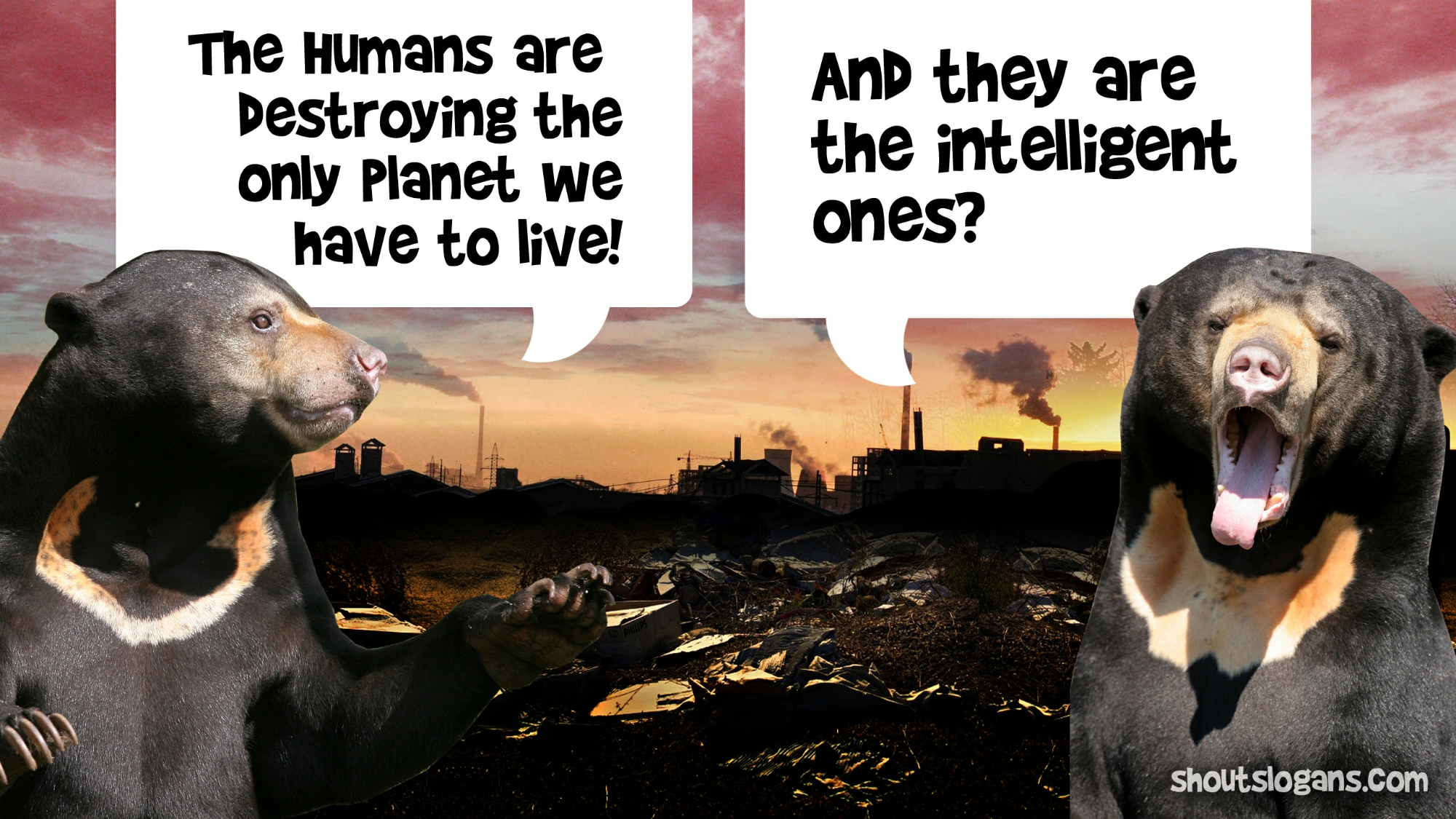
What to expect as we ignorantly destroy “Mother Earth”

image

I live in the part of Enugu, Nigeria, where there are many trees. Whenever I retire from the hustle and bustle of urban Enugu, I regain respite from the serenity and naturalness of my suburb-home. I’ve always loved it, especially the characteristic fresh air and the inspiring quietude. We even have a small stream there. Sometimes I just go down there to clear my head, especially whenever it looks like I’d exhausted all available options on a given matter. We also have a beach there, one full of fine sand and water; very beautiful and scenic. I’ve been there just ones, but that ‘just ones’ gave me an unrepeatable and unforgettable experience. To say the least, my suburban neighborhood is chic!

Did I just say, “is chic”? That was a mistake; I meant to say “was chic.” I’m even already contemplating moving from there. What happened, you may be wondering. Simple: the guys from town came around. And you can already guess what’s happening there right now. Yes, it is so bad that someone already built a house right next to the stream, and, as it were, destroying the awe-inspiring vegetation that made me fall in love with that stream. In fact, the last time I went there was a long time ago. What about the beach? The first and only time I visited revealed that things were already falling apart: tippers move hundreds of trips of sand away from it every single day; others have turned the place into a mining site for stone – they just keep digging and digging. What about the trees? You can be sure that at least a couple of trees go down every single day.

There is something I particular noticed with the plunderers of my beloved suburb: ignorance. I watch the man chopping down the trees and all I notice is that the trees being fell appear to be his only problem on this whole wide earth. He appears not to be in the know that he is contributing his quota to the problem we’re all suffering now: climate change. I watch the man moving the sand from the beach and the one digging up stones, and all I see are people who are trying to either make ends meet or secure a better life for their family and other dependants. I look at the man knocking down trees and erecting condominiums, and all I see is a man trying to secure assets for the security of his and his family’s financial future.

On a second thought, what if they knew? What if they all knew that their actions were negatively impacting on humanity’s collective future? Would they have called it a quit? I doubt. The fellow who doesn’t know the meaning of ‘climate change’ may be excused, but some of the guys responsible for gas flaring at refineries are products the Ox-bridges. Some of the many factories in China and America that produce fumes and toxic wastes substantial enough to turn things upside-down are state-owned. Come to think of it, too, if the village stark illiterate were to be told the implications of felling trees, bush burning and other sundry activities that warm up the globe, would he/she stop? I doubt. At the end of the day, we’re all guilty as charged. Humans are somehow wont to having their way today regardless of future consequences.

The past weeks have been terribly hot in Enugu, and everyone is gone acomplaining. The complaint is so heavy that someone wondered if the last person that entered hell left the door ajar, such that some of the heat from the eternal burning fire of hell is getting to us. Of course, very very few remember that what goes around comes around; we sowed heat and we’re getting warmed.

Truth be told, it’s never been known that one ate his/her cake and still had it. And, it’s never gonna change now.