PLEASE TELL THEM

< …for your own good >

Year in, year out, the gospel reading for Ash Wednesday – Catholic – is Matthew 6:1-6,16-18. There, Jesus outlines the terms and conditions applicable to having heaven reward piety, illustrated with almsgiving, fasting, and prayer. ‘When you give, don’t let as much as your left hand see what your right hand is doing’ – not to talk of a full human being; ‘When you pray, shut the door and do so in private’; ‘When you fast, don’t advertise it through gloomy looks’: these gestures are addressed to your heavenly father, and as such be known to him alone. Hence, human applause and admiration over them only serves to water down the graces they confer, the rewards they accrue.
Now, the problem is that many pious fellows fail to see the limit of the application of the above text, failing to realize those times when the rewards of certain actions, good deeds so to speak, are within the province of fellow human beings, and as such shouldn’t be done secretly or kept so, as human beings are incapable of seeing what was done in secret or knowing what’s been kept away from them. And should they not get to see or know about them, how then are they expected to reward you? Dear friend, we need all the wisdom to know when blowing our trumpet by ourselves is both right and just – and even a duty we owe ourselves.

Recall that fateful day when Saul fell into the hands of David. His men kept urging him to take advantage of the opportunity God had just given him to take out a king that was after his life with as many as 3,000 of the finest soldiers in Israel. And David refused, particularly on the grounds of not laying as much as a finger on the Lord’s anointed. What did David do next, I ask you? Keep it secret so that God who saw what happened in secret would reward him? Not at all! David knew enough that the reward he sought was in the king’s hand, to spare his life. And then he goes faraway, from where he announced to Saul what kindness he’d just shown him, how he refused to cash in on the opportunity he had moments earlier to slay him. Read 1 Sam 24 for the full gist; Saul even wept.

My point exactly: You need to be clear about the source of your reward per time. Know when it is God, and keep your deed secret, ensuring that the applause and admiration of fellow humans don’t rob you of your reward; know when it is fellow humans, and make it known to them – with discretion. If you do good to friends, siblings, spouse, colleagues, boss, neighbours, etc., be sure you make it known to them in some way – for the record. To them, not the general public, else your reward could also be watered down by their comments, applause, and admiration. Yes, I think people like to know what you’ve done for them so they can queue you up for Reward Day. And this reward comes in various shapes and sizes: upgrade your status, like you better, love you more, get you promoted, help advance your cause or move your ministry to the permanent site, forgive you more easily should you screw up in the future, speak graciously of you going forward, go all out to plead your cause, generously refer or recommend you, etc. Of course, cash is not exempt.

In these evil days, those who go out of their way to do good deserve some accolades – whether from God or fellow humans. Just know which counter to go cash your cheque; none deserves to bounce.


NEXT LEVEL CLEARANCE

< How to live for the future now >

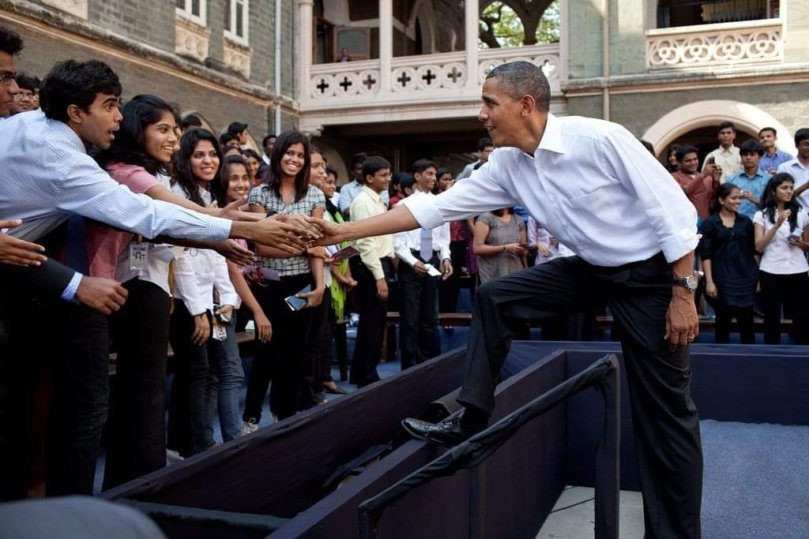
Barack Obama didn’t become “44” in the way you’d imagine. I mean, 44th POTUS. Interestingly, he was handpicked from a street corner by Kerry and sold to the American voters. By ‘street’ I don’t mean he was roaming the streets in the way we know; it’s the fact that Kerry experienced Obama’s magic at a small fundraising by a street corner and immediately saw the next US president in him. To make it come true, he simply arranged to have him be the keynote speaker at the 2004 Democratic Convention, where next to everyone was left in no doubt that ‘change has come to America.’ Of course, by the very next convention, 2008, he was there again to announce his candidacy for president. Without mincing words, Obama showed up to that big stage, 2004 Democratic Convention, wearing the badge of his ‘next level clearance’ – and everyone was in no doubt. And we all know that it ended in praise.

Down here, in Nigeria, a certain man ran for president more than once to no avail and decided to settle for governor. And, for a whopping 8 years as governor, succeeded in proving to all and sundry that it’d have been a big mistake to have obliged his request for our votes in 2003 – and 2007 – for the highest office in the land. Now, he would almost certainly never be president. Why? Because he failed to secure a ‘next level clearance.’

Lemme share something quite personal with you. I woke up yesterday, Sunday, feeling plenty, plenty things – as expected. And so I decided to turn my gaze to God, to have him say something to me. As if the heavens conspired in my favour, I found the perfect words with which to call his attention, Psalm 27:8-9, “Of you my heart has said, ‘seek his face.’ It is your face, O Lord, that I seek. Do not hide your face from me.” And in a remarkable turn of event, and I knew it was Him, he led me straight to a friend’s bookshelf, got me to pick a particular book, and got me to reading the book from the back, and then I found it! By the way, the book is Wallace D. Wattles’s “The Science of Getting Rich.” Kindly read it, whatever it may take you.

Here’s what I found, and I do care to share with you: YOU CAN’T MAKE IT TO THE NEXT LEVEL UNTIL YOU SECURE CLEARANCE FOR IT. What that? Here’s Wallace’s exact words, “Every person who does one thing perfect is instantly presented with an opportunity to begin doing the next larger thing.” And if you’re complaining about your environment, he says to you, “Your only way of reaching a better environment is by making constructive use of your present environment. Only the most complete use of your present environment will place you in a more desirable one.”

The point is: Who you are, what you have, and where you are, already hold the magic to whoever you wish to become, whatever you want to have, and wherever you desire to go. But you must first prove faithfulness in little things (how effective you are at the current level), which is what will give you clearance for the next level. Funnily, you won’t be needing to figure out how to actually get to the next level; you will just wake up one day to find yourself there. This principle delivers like magic.

This revelation meant something to me, at a personal level. I hope I didn’t bore you.

Your No. 1 fan,
Cornel

THE GIFT OF SPOTLIGHT

< One thing every leader should learn from President Trump >

It’s an interesting time to be alive; at a time when a drama king occupies the most powerful house on the planet, the White House, and has under his command the finest army and weaponry anywhere on the face of the earth. It is of little doubt that Trump’s presidency is the most interesting thing that’s been happening on earth since its inception on January 20, 2017. Next to every morning, the world wakes up to something startling from him, usually on his Twitter handle. And not even the Great Ones are exempt; his ‘Great Again’ mantra means that he’s particularly impatient with Russia’s Putin and China’s Xi, who both appear to be giving America a run for world’s No.1.

For me, it’s being a long time knowing Trump, through his books. From “Surviving the Top,” through “The Art of the Deal,” to “Great Again,” the man remains consistent. He is that gutsy author, one whose books could pass for crack cocaine; you don’t get to remain the same after sniffing in his ideas, all of them characteristically contrarian; he drives you nuts with highness. That’s on a lighter note, though. I wouldn’t know what you think about Trump, or how exactly you feel about him; this piece is simply about one thing I feel every leader should learn from him.

Every day is someone’s birthday, and February 5, 2019 happened to be Judah Samet’s 81st – a member of the Tree of Life Synagogue in Pittsburgh who had survived Hitler’s Holocaust decades earlier, and in 2018 a horrific shooting that killed 11 members of his community. That day was also State of the Union, the most important day in the life of a sitting US president. On that day, the POTUS would stand before a joint session of Congress, all of America, and indeed the rest of the world, to announce the strength of the American union, one that’s been a long time coming. Of course, such an announcement could only come after a long argument establishing its grounds. Trust me, there’s no better day to know how truly proud American can be; the POTUS gets to look the rest of the world in the eyes and boldly and proudly allude that God entrusted custody of the planet to them.

On that one of four most hallowed days of Trump’s presidency, he was not so busy being president that he forgot Judah. I kept looking into Judah’s eyes through the rest of the speech and could feel him reciting the ‘nunc dimittis’ – “I can now die.” Trump spoke of him before the world as would rarely be spoken of a human being alive. And when Congress learnt that it was Judah’s birthday, Trump let them sing to the finish the usually sensational happy birthday song, immediately after which Trump added – on a lighter note, “They wouldn’t do that for me, Judah.” And it wasn’t only Judah, as Trump also gave a number of his special guests the gift of spotlight, including: Elvin Hernandez, Buzz Aldrin, Timothy Matson, Ashley Evans, Joshua Kaufman, etc. From my end, I could feel every one of them feeling like it were the very best day of their lives, the happiest, and the most meaningful.

What should leaders learn from Trump? It is this: Be stupendously generous with the gift of spotlight; place people in the middle of the show, tell among the audience the good they’ve done, and genuinely shower them with praises in the loudest way possible. At those points, don’t compete for the spotlight with them; you already have it. Publicly give them credit for the role(s) they played, and let them be in no iota of doubt as to how much difference they made. If you do this always, and sincerely, then you’d rarely encounter loyalty issues.

I think so.

Your No.1 fan,
Cornel

Perfection is God’s business

aaaaa

Nowhere was the picture of the fact that all human beings are imperfect so clearly painted as at the scene in the Christian Bible where Jesus charged the Jews who were pressing to stone-to-death the adulterous woman, thus: “Let he who is without sin be the first to cast a stone.” True to the fact that none of them, oldest to youngest, was without sin, it wasn’t so long before the crowd melted down, Read More »

Leadership 2.0: Rediscovering Leadership

1

Leadership is one of those words that can do without the dictionary, as only a handful of people are in want of its meaning. The word is so much in common usage that it ranks among the so-called household words. And the reason is not far-fetched: leadership is ubiquitous; leaders are everywhere. Yes, the father heads the family, the principal administers the school, the community head ensures order therein, the governor pilots the affairs of the state, the pastor pastures the flock of God, the president presides over matters of state, the Pope oversees the Holy See. What more could the dictionary say about leadership if not to restate the obvious.f course, the unintended consequence of the above thinking about leadership is that it causes one to identify leadership with headship, to equate leadership with administration, to restrict leadership to positions of authority, to domicile leadership in America’s White House, Nigeria’s Aso Rock, or Britain’s 10, Downing Street.

A sequel to the above is that one is forced to characterize leadership by the mannerisms in which those hitherto identified as leaders conduct their leadership business. Therefore, because the head of the family is wont to wielding the rod at the slightest provocation, the growing child gets socialized into thinking that rod wielding is integral to leadership; because the principal of a school lords it over his or her teachers and students, some students may begin to think that ‘lordship’ is a corollary of leadership; because the pastor of a church threatens to rain down fire from heaven at the slightest infraction of church rules, faithful followers begin to imagine that it is part and parcel of the leader’s job description to secure conformity through the issuance of threats and sanctions.

The preceding exposition aptly captures Leadership 1.0. In the Leadership 1.0 era, leadership was equal to headship; leadership was synonymous with lordship; leadership was resident in the head that bore the crown and the legs that wore the shoe. In that era, too, there was a clear-cut distinction between leadership and followership. Here, while the leader takes both the frontline and first position, the follower can at best be second; while the leader dishes out orders, the follower takes them and orders themselves accordingly; while the leader is blue-blooded, the follower has the usual red blood. For every groundbreaking feat, for instance, while the leader points to the ground, the follower breaks it.

However, gone are the days of Leadership 1.0. Welcome to the era of Leadership 2.0! Call it Advanced Leadership if you like. Mind you, it is not advanced for its sophisticatedness; it is advanced for its simplicity. It is advanced for its openness, making it possible, for the first time, for anyone who is interested in leadership to become one – blueblooded or red-blooded. As much as the father, a child can be a leader; as much as the CEO of a multibillion dollar company, a janitor can be a leader; as much as the Pope, a catechist can demonstrate leadership; as much as the master, a slave can have a bite of the leadership pie; as much as the ‘leader,’ a follower can have a taste of leadership.

Leadership 2.0 is a total rethink on leadership. In it, revolutionary thinking was brought to bear on the all-important enterprise of leadership. In fact, it is a revolt on Leadership 1.0. And the essence of Leadership 2.0 is to democratize leadership, to make it “of the people, by the people, and for the people.” It essentially distils out the core of leadership, and goes on to strip it of all the addenda and paddings that make it heavy and complicated.

What, then, is Leadership 2.0? Inspired by the works of the likes of John Maxwell and Robin Sharma, Leadership 2.0 locates leadership in one word, INFLUENCE. And the choice of this one word is not far-fetched, as every manifestation of leadership, even in the Leadership 1.0 experience, is built on it. By the way, ‘influence’ simply means “the power to affect, control or manipulate someone or something. Although ‘influence’ is significantly wielded by those who occupy positions of authority (the leaders of the Leadership 1.0 era), it is not at all their exclusive preserve; Leadership 2.0 insists that anyone, just about anyone, can wield ‘influence.’ This, of course, is another way of restating the fact that anyone can be a leader.

A classic example of Leadership 1.0 Vs Leadership 2.0 is the discovery of the external installation of elevators. El Cortez Hotel is one of San Diego’s famous hotels. Once upon a time, the hotel management decided to install an additional elevator to better serve guests. While the contracted engineers came up with complicated designs that called for cutting holes through each floor of the hotel, which, of course, will cost the hotel a fortune, and pile up mess for the janitor to clean up, the eventual solution came from the janitor’s comment: “You could build the elevator on the outside of the hotel.” Here, we learn that even janitors are capable of thinking outside the engineering box; they mustn’t have bagged an engineering degree, or registered with the engineering council.

A more ad rem example of Leadership 1.0 Vs Leadership 2.0 can be gleaned from Thomas Edison’s laboratory, in J.P. Morgan’s words, “where genius resides.” At 31, Edison already had about 400 patents to his credit, and had become one of the greatest scientists ever. The zenith of Edison’s scientific feats was the perfection of electricity. But it was the Direct Current, inferior to the later Alternating Current. Guess what? Both electricity current designs were developed in the same laboratory: Edison’s. However, while the boss (Edison) was responsible for the inferior one, D.C., the apprentice (Nicola Tesla) was responsible for the superior one, A.C. And when apprentice reported his development to boss, apprentice’s noble development was talked down on; Edison told Tesla his A.C. design couldn’t amount to much. The long and short of it is that Tesla’s A.C. later edged Edison’s D.C. out of the market, went on to crash the party on Edison Electric Company, and remains the electricity standard till date. In Leadership 2.0, as already stated, apprentice can do as much as, and even better than, boss.